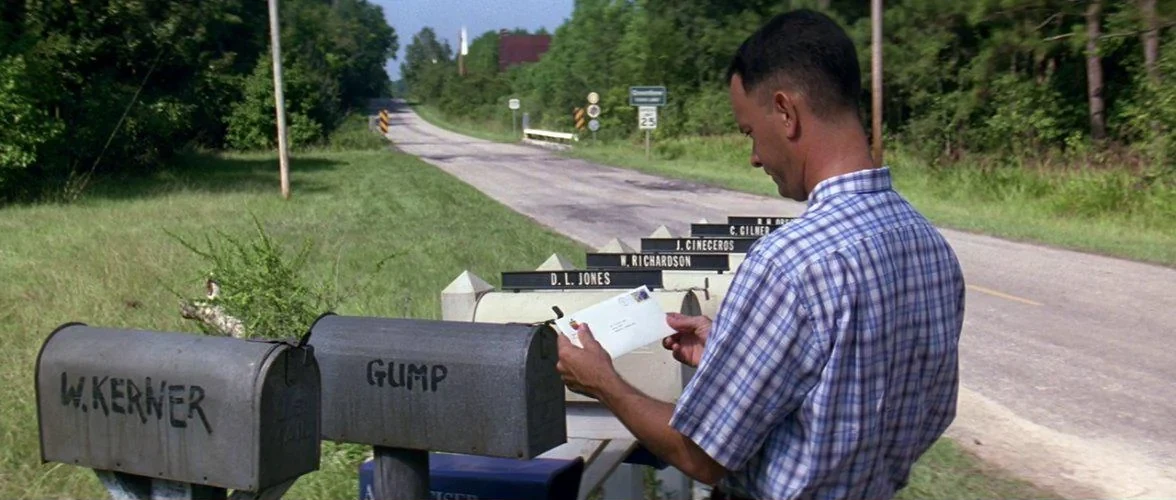
Some kind of fruit company.

Forrest Gump · Forrest Gump, 1994

Fruit Company Index

The investment Forrest never understood.

Data confidence: Verified Quote unverified
Film
Forrest Gump (1994)
Base year
1994
Indexed unit
$1,000 in Apple stock, dividends reinvested
Geography
United States
Currency
USD

$1,000 in Apple on the day the film released. Nothing added since.

Value at 1994

$1,000

Value at last verified date (2025)

$1,020,000

Forrest could not have explained a single thing about the company. He held it for thirty-one years, which turned out to be the harder skill.

Nominal change
+101,900%

1994 to 2025, unadjusted

Compound annual growth
+25.0% a year

Across 31 years

1994 value in 2025 money
$2,173

Base value restated using CPI

Real appreciation
+46,831%

Net of general inflation

Latest observation
Provisional

The 2025 figure is not yet final. Values on this page will move when it publishes.

Base year — Release year of Forrest Gump. The film's investment happens in the 1970s, before Apple was public — you could not have bought it. The release year is the earliest date the trade is actually possible, and that gap is worth knowing.

01The series

What it was worth, each year

Nominal local currency by default. Switch modes to strip out inflation, express the figure as earning time, or read it as quantity and percentage change.

Value in the currency of the day, unadjusted.

$0$285.6K$571.2K$856.8K$1.14M19941999200420092014201920242025Base 19941997: Near bankruptcy2001: iPod2007: iPhone2008: Financial crisis2020: Four-for-one split

Focus the chart and use ← → to walk the series, Home and End for the ends, Escape to clear.

Apple, $1,000 invested in 1994S&P 500, $1,000 invested in 1994InterpolatedProvisional
$1,000 in Apple stock, dividends reinvested — Apple, $1,000 invested in 1994: $1,000 in 1994, $1,020,000 in 2025 — an increase of 101900.0% across 32 annual observations.

Did it outrun the benchmarks?

  • S&P 500, total returnOutran

    1,020.0× vs 24.8×

    The comparison that matters. Buying the whole market took no conviction and no luck.

  • US CPI, all itemsOutran

    1,020.0× vs 2.2×

    How much of the gain survives thirty-one years of inflation.

02Calculation

The complete equation

Not a footnote. Every step, every number, the dataset it came from and the rounding rule applied to it.

  1. $1,000, 1994

    equals the position

    Bought at the close in the film's release year.

    Source: Nasdaq / CRSP

  2. × 2 × 2 × 7 × 4

    equals 112 shares for every one held in 1994

    Splits in 2000, 2005, 2014 and 2020. Ignore them and the return looks a hundred times smaller.

    Source: Nasdaq / CRSP

  3. + dividends reinvested

    equals from 2012 onward

    Apple paid nothing for the first eighteen years of the holding.

    Source: Nasdaq / CRSP

  4. = $10,20,000

    equals value at the last verified date

    2025. Provisional.

    Source: Nasdaq / CRSP

Conversion — The series already tracks a $1,000 position, adjusted for all five splits since 1994 and for dividends reinvested from 2012.

03Affordability

Price is only the first question

How much it cost, how much the underlying thing appreciated, and how hard it was for a person to afford — three different questions with three different answers.

What the old money buys

What the 1994 outlay of $1,000 would buy at 2025 prices.

1994 prices1 positions
2025 prices0 positions

The same money buys 0.1% of what it did — the rest is price.

Inflation-adjusted value

What the 1994 price is worth in 2025 money, against what the thing actually costs.

1994 price, restated$2,173
2025 price, actual$1,020,000

Real appreciation of +46,831%. This part is not inflation — $1,000 in Apple stock, dividends reinvested genuinely got dearer.

04Interpretation

What drove the change

A thousand dollars becomes roughly a million. That is the number everyone shares, and on its own it teaches nothing — it is a survivor picked with hindsight from a market full of companies that went to zero.

The comparison is the lesson. The same thousand dollars in the S&P 500 became about twenty-five thousand: a good result, achieved with no research, no conviction and no risk of losing everything. Apple beat it by a factor of forty, and to collect that you had to hold through 1997, when the company nearly failed and the position was worth half what you paid.

The splits do most of the quiet work. Four of them since 1994 turned one share into a hundred and twelve. Anyone reading a raw 1994 share price against a 2025 one, without adjusting, would understate the return by roughly that same factor — which is the most common mistake made with long-run stock charts.

One product, twice

The iPod and then the iPhone account for most of the compounding. Two decisions, thirty-one years apart from the base date.

Surviving 1997

The position lost half its value and the company was months from running out of cash. Every subsequent return depends on not having sold there.

Buybacks

Apple has retired a large share of its own stock since 2012. Each remaining share owns more of the company than it did.

Survivorship

This index prices the one that worked. The honest version of the lesson includes every fruit company that did not.

What this index does not claim

  • The film's investment predates Apple's IPO. The trade in the film could not have been made; this index prices the earliest date it could.
  • No tax, brokerage or currency conversion is applied. A real holder would have kept less.
  • Dividends are reinvested, which assumes no cash was ever taken out over thirty-one years.
  • Chosen with hindsight. Picking a stock that returned a thousand-fold is easy in 2025 and was not in 1994.
  • The quote is paraphrased and not checked against the film or authorised subtitles.
05Provenance

Source ledger

Every dataset behind this page, with the adjustments applied on the way in and how gaps are treated. Last verified 31 December 2025.

  • Apple Inc. total return — value of $1,000 invested, split- and dividend-adjustedNasdaq historical prices, corporate actions and dividend recordsData confidence: Verified19942025
    Publisher
    Nasdaq historical prices, corporate actions and dividend records
    Date range
    1994-01-01 to 2025-12-31
    Geography
    United States
    Frequency
    annual
    Original unit
    $ per share, close
    Normalised unit
    $ value of a $1,000 position, dividends reinvested
    Currency
    USD
    Adjustments
    Adjusted for all five splits since 1994 (2:1 in 2000 and 2005, 7:1 in 2014, 4:1 in 2020) and for dividends reinvested from 2012. No tax, brokerage or currency conversion is applied.
    Missing data
    None. The 2025 value is provisional pending the year-end close.
    Last checked
    2025-12-31
    Licensing
    Public market data, cited with attribution
  • S&P 500 total return — value of $1,000 invested, dividends reinvestedS&P Dow Jones Indices, S&P 500 Total ReturnData confidence: Verified19942025
    Publisher
    S&P Dow Jones Indices, S&P 500 Total Return
    Date range
    1994-01-01 to 2025-12-31
    Geography
    United States
    Frequency
    annual
    Original unit
    Index level, total return
    Normalised unit
    $ value of a $1,000 position, dividends reinvested
    Currency
    USD
    Adjustments
    Gross total return: no fund fees, tax or tracking error.
    Missing data
    None. The 2025 value is provisional.
    Last checked
    2025-12-31
    Licensing
    Cited with attribution
  • CPI for all urban consumers, all items — annual average, 1982–84 = 100U.S. Bureau of Labor StatisticsData confidence: Verified19942025
    Publisher
    U.S. Bureau of Labor Statistics
    Date range
    1994-01-01 to 2025-12-31
    Geography
    United States (urban)
    Frequency
    annual
    Original unit
    Index, 1982–84 = 100
    Normalised unit
    Index, 1982–84 = 100
    Currency
    USD
    Missing data
    None.
    Last checked
    2025-12-31
    Licensing
    Public domain (US federal statistics)

Pop Indices is editorial and educational. Historical returns are described, never projected, and nothing here is investment advice. Film titles, characters and dialogue are referenced for commentary and remain the property of their rights holders.

Take it with you

The card carries its own provenance

A figure that travels without its source is the thing this section exists to avoid, so the export always includes the credit line.

Share
1080 × 1080 · square posts everywhere